Luxury Redefined: How the Next Generation of Wealthy Buyers Is Reshaping What a Prestige Home Must Be
For much of the twentieth century, the luxury home served a relatively straightforward purpose: to communicate. Its scale communicated success. Its address communicated status. Its finishes communicated taste. The home was, in a meaningful sense, a statement directed outward—toward neighbors, peers, and the broader social world.
That model is not disappearing. But it is being substantially complicated by a generation of wealthy buyers who have grown up with a different set of preoccupations—and who are bringing those preoccupations to bear on one of the most consequential purchasing decisions of their lives.
The result is a market in active transformation, one in which the definition of true luxury is being renegotiated in real time.
A Different Kind of Affluence
The buyers reshaping today's luxury market are not a monolith. They include inheritors of multigenerational family wealth who have internalized a stewardship ethic that their predecessors may not have emphasized. They include founders and early employees of technology, finance, and media companies who accumulated significant wealth relatively quickly and who carry the intellectual frameworks of those industries into their consumer choices. And they include a growing cohort of high-earning professionals—physicians, attorneys, executives—whose financial profiles qualify them for the luxury market but whose values were shaped by an era of heightened awareness around climate, wellness, and social responsibility.
What these buyers share, across their considerable differences, is a conviction that a home worth owning at a premium price must justify that premium in terms that extend well beyond marble countertops and square footage.
"The conversation has completely changed," observes one luxury buyer's agent who works with clients across California, Colorado, and the Pacific Northwest. "Five years ago, a buyer might ask about the view and the kitchen. Now they ask about the solar array, the HVAC efficiency rating, the air filtration system, and whether there's a dedicated space for a meditation practice. These are not afterthoughts. They are primary considerations."
Sustainability as a Non-Negotiable
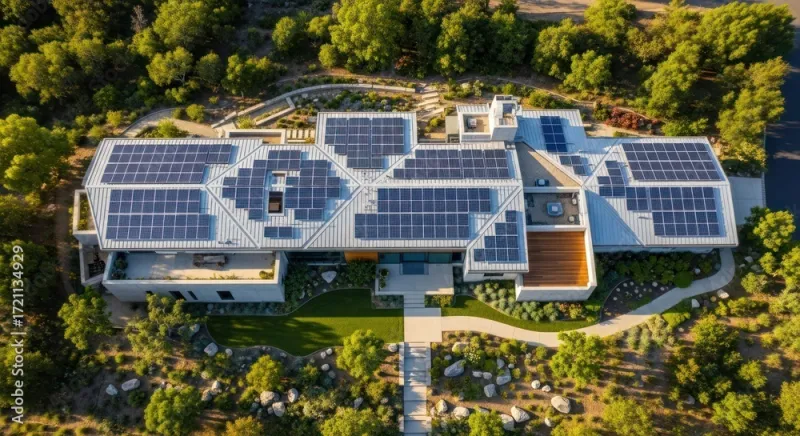
Perhaps the most structurally significant shift in buyer priorities involves environmental performance. For the next generation of luxury buyers, sustainability is not a marketing talking point—it is a baseline expectation, and increasingly, a dealbreaker when absent.
This translates into specific, measurable demands. Geothermal heating and cooling systems, which dramatically reduce a home's carbon footprint while also lowering long-term operating costs, have moved from novelty to near-standard in the highest tier of new construction. Whole-home battery storage systems, paired with rooftop or integrated solar generation, allow buyers to achieve meaningful energy independence—a consideration that carries both environmental and practical appeal in an era of increasingly unreliable grid infrastructure.
Building envelope performance—the insulation, fenestration, and air sealing that determine how efficiently a home retains conditioned air—is receiving an unprecedented level of scrutiny. Certifications such as LEED Platinum, Passive House, and the Living Building Challenge, once the province of progressive commercial construction, are appearing with increasing frequency in luxury residential projects.
From an investment standpoint, this trend carries significant implications. As energy codes tighten and buyer expectations continue to evolve, homes that fail to meet modern sustainability standards face a meaningful risk of obsolescence—a consideration that sophisticated investors are beginning to price into their acquisition decisions.
Wellness as Architecture
If sustainability represents a values-driven demand, the wellness movement represents something equally powerful: a deeply personal one. The pandemic accelerated an already-growing awareness among affluent Americans that the home environment has a direct and measurable impact on physical and mental health. The response, in the luxury market, has been the emergence of what might be called wellness architecture—the systematic integration of health-promoting features into the design and construction of a residence.
At the most visible level, this means dedicated wellness spaces: private gyms equipped to professional standards, sauna and cold plunge installations, yoga and meditation rooms designed with acoustic isolation and carefully calibrated natural light. But the wellness imperative extends well beyond discrete amenities.
Circadian lighting systems, which automatically adjust the color temperature and intensity of artificial light throughout the day to support the body's natural rhythms, are becoming a hallmark of the most sophisticated new construction. Whole-home air purification systems—capable of filtering particulates, volatile organic compounds, and pathogens to levels that rival clinical environments—are increasingly specified alongside traditional HVAC systems. Water filtration at the point of entry, providing purified water to every tap in the home, has become a standard expectation rather than a luxury upgrade.
"These buyers have read the research," says one architect who specializes in high-performance residential construction. "They understand that the quality of the air they breathe and the light they live under affects their sleep, their cognition, and their longevity. They are not willing to compromise on that, regardless of cost."
The Return of Multigenerational Living
A third dimension of this values-driven transformation involves the physical organization of the home itself. For decades, the dominant model of luxury residential living in the United States was nuclear and relatively compact—a primary residence designed for a couple and their children, with guest accommodations as a secondary consideration.
That model is giving way to something more expansive and more deliberately intergenerational. Aging parents who wish to remain close to their adult children—and grandchildren—are driving demand for what the industry has come to call "multigenerational" floor plans: homes designed with two distinct primary suites, separate entrances, or fully independent accessory dwelling units that provide privacy and autonomy while maintaining proximity.
Simultaneously, adult children of wealthy families are increasingly choosing to remain in or return to proximity to their parents, drawn by a combination of economic pragmatism and a genuine revaluation of family connection that the pandemic years catalyzed. The result is a generation of luxury buyers who are purchasing not just for themselves, but with their parents, their children, and their grandchildren explicitly in mind.
For developers and architects, this represents both a challenge and an opportunity. Homes that can accommodate multiple generations gracefully—without sacrificing the privacy, aesthetics, or amenity standards that luxury buyers demand—command a meaningful premium and occupy a distinct and underserved position in the market.
Investment Implications for the Discerning Buyer
For those approaching the luxury market with an investment orientation, the implications of these shifting values are substantial. Properties that incorporate genuine sustainability performance, thoughtfully designed wellness infrastructure, and flexible multigenerational accommodation are not merely more appealing to today's buyers—they are more resilient to the obsolescence risk that threatens conventionally designed luxury homes as the market continues to evolve.
At Belle Hills, we believe that the homes being built and acquired by this generation's most thoughtful buyers will define the standard against which all luxury residential properties are measured in the decades to come. Prestige, in this emerging paradigm, is not simply a matter of location or finish level. It is a reflection of the values and the vision of the people who inhabit these extraordinary spaces—and who are, in the most meaningful sense, building a legacy that extends well beyond the walls of any single home.