Green as the New Gold: How Sustainable Design Is Elevating Luxury Property Values
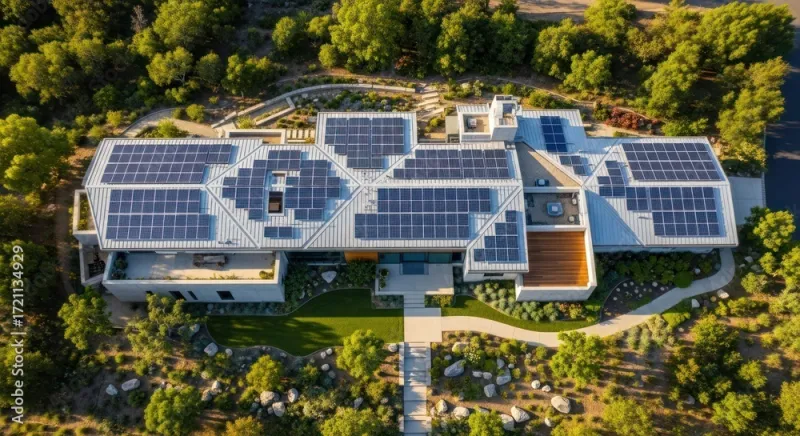
Photo: luxury sustainable estate home solar panels modern architecture aerial view, via as2.ftcdn.net
For decades, the calculus of luxury real estate rested on a familiar set of variables: location, square footage, architectural pedigree, and the caliber of finishes within. Today, a new variable has entered the equation with considerable force. Environmental sustainability — once considered a peripheral concern for the ideologically motivated — has become a defining criterion for a growing segment of America's most sophisticated property buyers. And where discerning demand leads, valuations reliably follow.
At Belle Hills, we have observed this shift not as a fleeting trend but as a structural realignment in how prestige is defined and priced. The implications for both lifestyle and investment are substantial.
The Demand Shift Among Affluent Buyers
The modern luxury buyer occupies a different psychological space than their predecessors. Wealth accumulated through technology, finance, and entrepreneurship has produced a generation of high-net-worth individuals who are deeply attuned to systemic risk — including environmental risk. These buyers are not purchasing a home solely as a symbol of achievement. They are constructing a long-term asset that must perform across multiple dimensions: aesthetically, financially, and increasingly, ecologically.
According to research published by the National Association of Realtors, energy-efficient homes consistently command price premiums over comparable conventional properties, with some studies indicating differentials of eight to twelve percent in competitive luxury markets. In coastal California, the Pacific Northwest, and select Sun Belt communities, that premium climbs further when properties carry recognized green certifications such as LEED Platinum or ENERGY STAR.
What is driving this willingness to pay more? In part, it is the financial logic of reduced operating costs — geothermal heating systems, solar arrays, and smart energy management platforms can reduce annual utility expenditures by tens of thousands of dollars on large estate properties. But the motivations extend well beyond the utility bill.
Conservation Easements as Strategic Instruments
Among the more sophisticated tools available to luxury property owners, conservation easements deserve particular attention from an investment perspective. A conservation easement is a voluntary legal agreement between a landowner and a qualified land trust or government entity, permanently limiting certain uses of the land to protect its conservation values.
For estate owners with significant acreage — whether in the Hudson Valley, the Colorado Rockies, or the rolling horse country of Virginia — a well-structured conservation easement can yield substantial federal tax deductions, reduce estate tax exposure, and simultaneously enhance the property's exclusivity. Land that cannot be further subdivided or commercially developed becomes inherently more scarce, and scarcity, in prestige real estate, is the ultimate luxury.
Several notable estates in New England have leveraged conservation easements to protect contiguous forest and meadowland while simultaneously positioning their properties as irreplaceable ecological assets. The result has been both a preservation of natural character and a compelling investment narrative for future buyers who understand the value of protected land.
The Technology of Responsible Living
Sustainability in the contemporary luxury home is not expressed through austerity. It is expressed through engineering elegance. The finest eco-conscious estates today incorporate systems that are as impressive technically as they are responsible environmentally.
Consider the geothermal heat pump installations now appearing in high-end properties across the Midwest and Northeast. These systems harness the stable thermal energy of the earth itself to provide heating and cooling with remarkable efficiency, eliminating dependence on fossil fuels without sacrificing comfort. Paired with rooftop or ground-mounted photovoltaic arrays and whole-home battery storage systems — such as those offered by Tesla's Powerwall platform or comparable enterprise-grade alternatives — an estate can achieve effective energy independence, insulating its owners from grid volatility and utility rate increases alike.
Water stewardship represents another frontier. Luxury estates in drought-prone regions such as Southern California and the Southwest are increasingly incorporating greywater recycling systems, rainwater harvesting infrastructure, and drought-tolerant native landscaping designed by specialized horticultural consultants. These investments reduce municipal water dependency while preserving the lush, curated aesthetic that prestige buyers expect.
Market Appreciation: The Evidence From the Field
The financial case for sustainable luxury properties is no longer theoretical. In Marin County, California, a renovated mid-century estate retrofitted with passive solar design, triple-pane glazing, and an integrated energy management system sold for fourteen percent above its initial listing price — a differential attributed in part to its green credentials in a market where environmentally aware buyers compete aggressively for well-appointed properties.
In the Pacific Northwest, timber-frame custom homes built to Passive House standards — an exacting certification requiring near-zero energy consumption — have attracted significant buyer premiums, with brokers reporting that the certification itself functions as a marketing asset that shortens time on market.
Perhaps most telling is the trajectory of luxury developers who have embraced sustainability as a core design philosophy rather than an afterthought. Firms specializing in net-zero estate construction report waitlists extending twelve to eighteen months, a clear signal that demand is outpacing supply in this particular segment.
The Intangible Premium: Identity and Legacy
Beyond the financial calculus, there is a dimension of sustainable luxury that resists easy quantification but proves equally compelling to the buyers Belle Hills serves. Ownership of a property that actively contributes to ecological health — that sequesters carbon, supports native biodiversity, and operates without net environmental harm — confers a form of distinction that no imported marble or hand-forged hardware can replicate.
For buyers who have devoted their careers to building something of lasting significance, the prospect of a home that embodies those same values is profoundly appealing. It transforms a real estate acquisition into a statement of identity, and in the highest echelons of the market, identity is the ultimate luxury.
The sustainability premium, in this light, is not merely a market phenomenon. It is a reflection of what the most thoughtful buyers now understand a prestige property to mean: not simply a place of exceptional beauty, but a place of exceptional purpose.
A Considered Approach for the Discerning Investor
For those evaluating sustainable luxury properties as investment vehicles, several principles merit consideration. First, prioritize certifications with rigorous third-party verification — LEED, Passive House, and ENERGY STAR carry market credibility that proprietary green claims do not. Second, engage specialists in conservation finance when evaluating properties with significant natural acreage, as the tax and estate planning implications can be transformative. Third, recognize that the sustainability premium is not uniform — it is most pronounced in markets with environmentally conscious buyer pools and in properties where green features are integrated architecturally rather than appended cosmetically.
At Belle Hills, we remain committed to guiding our clients through the evolving landscape of prestige property with the same rigor and discernment that defines the communities we represent. In an era where green has become gold, that guidance has never been more consequential.