The Architecture of Silence: Why Acoustic Engineering Has Become a Hallmark of the Truly Exceptional Home
There is a particular quality of stillness that distinguishes a truly exceptional home from one that merely appears exceptional. It is not visible in the marble of the foyer or the grain of the custom millwork. It is not captured in a photograph or conveyed through a floor plan. It is felt—or more precisely, it is heard in what is absent: the neighbor's conversation that never penetrates the study wall, the street traffic that dissolves before it reaches the master suite, the home theater whose resonance remains perfectly contained within its carefully engineered chamber.
Acoustic design has quietly ascended to become one of the most consequential—and most underappreciated—dimensions of luxury residential architecture. For the nation's most discerning buyers, the ability to control and curate the soundscape of a home is no longer a specialty request. It is a baseline expectation.
From Concert Hall to Custom Residence
The science of architectural acoustics has long been associated with institutional spaces: symphony halls, recording studios, houses of worship. The principles governing how sound travels, reflects, absorbs, and dissipates within a built environment are well established. What is comparatively recent is the deliberate application of those principles to private residential construction at the highest level.
Leading architectural firms that serve ultra-high-net-worth clients are increasingly engaging acoustic consultants at the earliest stages of design—not as a corrective afterthought, but as a foundational discipline. Decisions about wall assembly, floor systems, ceiling height, and even furniture placement are now informed by acoustic modeling that would have seemed extraordinary in a private home just a generation ago.
The result is a category of residence where sound behaves as the architect intended: contained where it should be contained, absorbed where absorption serves the occupant, and distributed with precision in spaces designed for music or entertainment.
The Engineering Beneath the Surface
For those unfamiliar with the technical vocabulary of acoustic design, the sophistication involved may come as a revelation. Modern acoustic engineering in luxury residential construction operates on multiple levels simultaneously.
At the structural level, vibration-dampening foundations and floating floor systems physically decouple living spaces from the mechanical vibrations transmitted through the earth—whether from nearby traffic, HVAC systems, or the subtle hum of neighboring mechanical infrastructure. In urban high-rises, this decoupling is particularly consequential, separating a penthouse from the ambient energy of the building beneath it.
Within individual rooms, wall assemblies incorporating multiple layers of specialized drywall, resilient channels, and high-density insulation achieve sound transmission class ratings that would satisfy a professional recording environment. Double-stud wall construction, in which two independent stud walls are built with an air gap between them, eliminates the direct structural pathways through which sound most readily travels.
Doors and windows—historically the most acoustically vulnerable elements of any room—receive particular attention in prestige construction. Solid-core doors with compression seals, triple-glazed windows with asymmetric glass panes, and acoustically rated frames combine to create barriers that address both airborne sound and the lower-frequency vibrations that standard construction leaves largely unaddressed.
The Rooms That Demand It Most
While acoustic consideration benefits every space in a well-designed residence, certain rooms have emerged as particular focal points for sophisticated sound management.
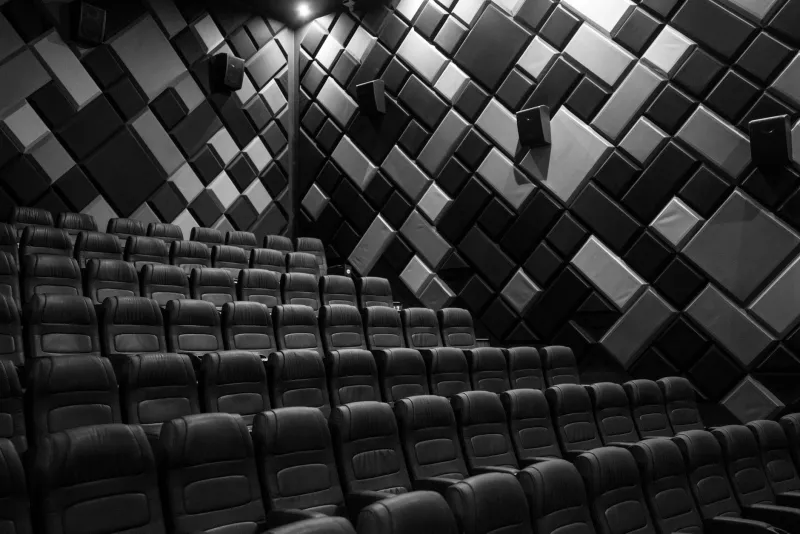
The home theater, long a standard amenity in luxury properties, has evolved from a room with a large screen and comfortable seating into a precisely calibrated acoustic chamber. Dedicated home cinema designers now employ anechoic principles, diffusion panels, bass trapping, and custom speaker placement protocols that rival the performance of commercial screening facilities. The finest examples achieve a listening environment of near-total sonic isolation—a space where the outside world ceases to exist entirely.
The private study or library represents another space where acoustic mastery pays profound dividends. For executives, attorneys, physicians, and others whose professional lives involve sensitive conversation or demanding concentration, a study that genuinely isolates its occupant from household activity is not an indulgence but a functional necessity. The psychological benefit of true acoustic privacy—the confidence that one's conversations are contained—cannot be overstated for individuals accustomed to operating at the highest levels.
Perhaps less obvious is the master suite, where the quality of sleep has become a recognized dimension of luxury living. Acoustic isolation in the primary bedroom, including sound-attenuating mechanical systems that eliminate the noise of forced-air heating and cooling, represents an investment in the most fundamental form of personal restoration.
Sound as Curated Experience
Acoustic design in the finest homes is not solely about elimination. It is equally about creation—the deliberate shaping of sound as an element of atmosphere and experience.
Whole-home audio systems integrated invisibly into architectural elements, from in-wall and in-ceiling speakers to acoustic panels that serve simultaneously as art objects, allow residents to layer sound throughout a property with a nuance that standard installation cannot approach. The transition from a kitchen where music plays softly to a dining room where it fills the space with controlled presence to a terrace where it fades into the ambient environment of the garden—this kind of intentional sonic journey is the work of acoustic designers who understand that sound is as much a part of interior atmosphere as light.
Some of the most innovative luxury properties currently under development in markets such as Palm Beach, Marin County, and the Chicago North Shore incorporate what designers term "acoustic zoning"—a spatial strategy in which different areas of a home are engineered to deliver distinctly different auditory experiences. A meditation room may be designed for near-total silence; a great room for lively, natural reverberation; a wine cellar for the particular resonance that makes conversation intimate and unhurried.
The Invisible Amenity That Defines the Difference
In a marketplace where the visible amenities of luxury—the finishes, the square footage, the views—have reached a level of near-universal availability among prestige properties, it is increasingly the invisible dimensions of a home that separate the exceptional from the merely expensive.
Acoustic engineering represents precisely this kind of distinction. It cannot be photographed. It does not appear in a listing description. It is experienced only in person, in the moment when a prospective buyer steps into a room and understands, perhaps for the first time, what genuine acoustic refinement feels like.
For those who have lived in that quality of silence—who have conducted a phone call without closing a door, slept through a thunderstorm undisturbed by the mechanical systems of the house, or watched a film in a private theater that rivaled any commercial experience—returning to an acoustically ordinary home becomes difficult to contemplate.
At Belle Hills, we believe that the homes worthy of exceptional buyers are defined precisely by these dimensions of experience that resist easy articulation. The architecture of silence is among the most eloquent statements a residence can make.