The New Meaning of Exclusive: How Affluent Buyers Are Reinventing Privacy in the Modern Era
The wrought-iron gate and the guardhouse at the entrance have long served as shorthand for a particular kind of American aspiration. For decades, the gated community represented the apex of residential exclusivity — a clearly demarcated world of manicured streets, shared amenities, and carefully managed access. Yet among today's most affluent buyers, that model is being quietly, and sometimes dramatically, reconsidered.
Privacy, it turns out, is a far more complex desire than a gate can satisfy.
The Limitations of the Traditional Model
Gated communities, at their best, offer a sense of security and a shared aesthetic standard. But they are, by definition, communities — with all the proximity, shared governance, and social obligation that the word implies. For buyers accustomed to a certain level of control over their environment, the homeowners association meeting and the shared tennis court can feel less like amenities and more like constraints.
There is also the matter of visibility. In an era of satellite imagery, social media, and the general collapse of informational distance, a gate at the entrance of a neighborhood offers only the most superficial form of discretion. A determined observer can identify the street, the lot, and often the structure itself with minimal effort.
It is this recognition — that true privacy requires more than a controlled entrance — that is driving one of the most significant shifts in the luxury residential market.
The Private Compound: Autonomy at Scale
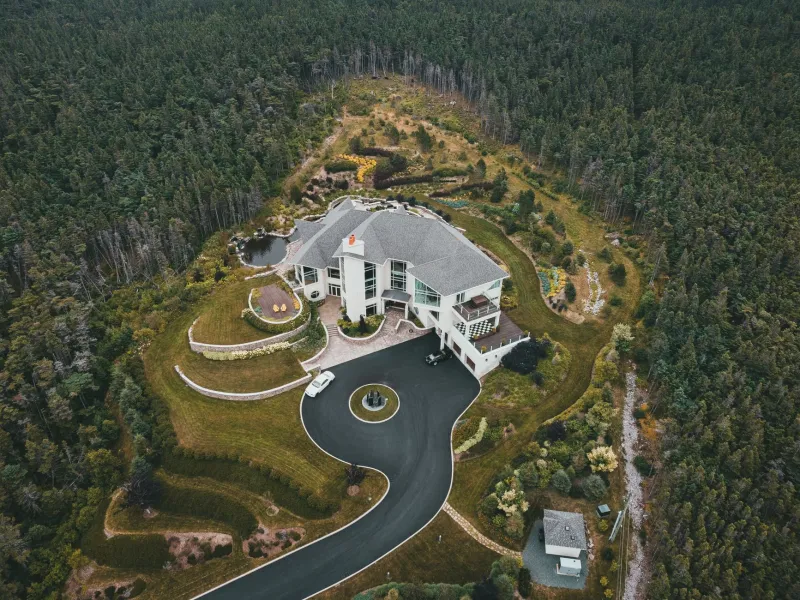
Among the alternatives gaining the most traction with ultra-high-net-worth buyers is the private compound: a substantial parcel of land — typically ranging from five to several hundred acres — on which a primary residence, guest structures, recreational facilities, and service buildings are arranged to create a self-contained world.
The appeal is straightforward. On a property of meaningful scale, the nearest neighbor is not a concern. The sightlines are controlled entirely by topography and planting rather than by shared covenants. The rhythms of daily life — arrivals and departures, gatherings, the simple act of moving through outdoor space — are unobserved by anyone who has not been deliberately invited.
Markets such as the Hill Country of Texas, the agricultural valleys of California's Central Coast, the rolling countryside of Virginia's Piedmont region, and the lake country of the Upper Midwest have all seen sustained demand for large-acreage estate properties from buyers who prize this quality of autonomy. In each of these regions, the defining characteristic of the most coveted listings is not the square footage of the main residence but the depth of the buffer between that residence and the wider world.
Curated Micro-Communities: Selective by Design
Not every buyer seeking privacy is seeking solitude. A growing cohort of affluent Americans — particularly those in their forties and fifties who have moved beyond the social imperatives of earlier career stages — are drawn to a more deliberate form of community: small, carefully curated residential enclaves where membership itself is the primary amenity.
These micro-communities typically comprise between eight and thirty residences, developed on shared land that may include private nature preserves, equestrian facilities, or resort-caliber wellness infrastructure. Access is not merely controlled by a gate but by an invitation process that functions more like a private club than a real estate transaction. Prospective buyers are often introduced by existing members and may undergo an informal vetting process before an offer is entertained.
Developments of this nature have appeared in markets ranging from the mountains of western North Carolina to the coastal reaches of Maine and the desert communities of New Mexico. What they share is a commitment to intentionality — the sense that every resident has chosen, and been chosen by, the community they inhabit.
"Our clients are not looking for a neighborhood in the conventional sense," explains one developer who has completed two such projects in the Southeast. "They want to know their neighbors, but on their own terms. They want shared values, shared stewardship of the land, and the freedom to retreat completely when that is what they need."
Amenities That Define the New Prestige
If the old model of exclusivity was defined by what was kept out, the new model is increasingly defined by what is drawn in. The amenities that distinguish the most coveted private estates and micro-communities today reflect a broader cultural shift toward wellness, sustainability, and experiential richness.
Private wellness infrastructure has become a near-universal priority. Dedicated spa facilities, cold plunge pools, infrared saunas, and meditation pavilions are standard expectations in the upper tier of the market. Buyers are not looking for access to a shared fitness center — they want the equivalent of a private spa integrated seamlessly into their daily environment.
Agricultural and equestrian programming speaks to a desire for connection with the land that is both aesthetic and functional. Working kitchen gardens, private orchards, and equestrian facilities are among the most frequently requested features in large-acreage estate searches, reflecting a broader aspiration toward self-sufficiency and intentional living.
Environmental stewardship has emerged as a genuine differentiator. Buyers at this level are increasingly drawn to properties that demonstrate meaningful commitments to land conservation, native planting, water management, and reduced environmental impact. The prestige of a conservation easement — which permanently protects land from development — is now comparable, in many buyers' estimation, to the prestige of a celebrated address.
Location as the Ultimate Luxury
Perhaps the most enduring insight from the evolution of the privacy market is that location — in its most fundamental sense — remains the irreducible luxury. Not proximity to a particular zip code or a celebrated street address, but rather the quality of the land itself: its topography, its orientation to light, its relationship to water, its natural buffer from the sounds and pressures of contemporary life.
At Belle Hills, we have always understood that the properties commanding the deepest loyalty from their owners are those where the land itself does the work — where the natural setting provides the first and most powerful layer of privacy, and where the residence is an extension of that landscape rather than an imposition upon it.
The new definition of prestige is not about exclusion for its own sake. It is about the deliberate creation of an environment in which life can be lived fully, on one's own terms, without compromise. That aspiration is timeless. Only the means of achieving it are changing.